Staxd Insights
AI Isn't a Cost Cut. It's a Capability You Couldn't Afford.
Most businesses look at AI as a way to cut costs. The real return is capability you could never have built or hired, available on tap, the way cloud gave us scale.
Andrew Economopoulos

Almost every conversation I have about AI starts in the same place: how much can we save?
It's a fair question. It's also the wrong one. After more than 20 years building technology for businesses, I think AI adoption looks far more like the move to cloud than any other shift we've lived through. And cloud was never really about saving money.
The savings are real. They're just not the point.
Cloud did bring savings. But nobody got them on day one.
First came the investment. Most businesses were still sitting on servers and data centres they'd already paid for, capitalised and depreciating on the books. Moving meant paying for the new world while still carrying the old one.
Then came the adoption curve. Software had to be modernised before it could move. Applications built for a server in the back room didn't simply lift and shift.
And then came the people. Systems administrators, network engineers, security and support teams all had to build a new capability set. The job didn't disappear. It became provisioning, automating and governing cloud environments.
None of that was a cost cut. It was an investment in a different way of operating.
What cloud actually gave us
Cloud gave us scale. You define a function and run it as much as you want, as fast as you want, because it's on tap. And when you don't need it, you turn the tap off.
That's the shift. Capability stopped being something you had to own outright and started being something you could draw on when the strategy called for it.
AI is the same shift
The numbers back this up. McKinsey's 2026 global survey of 1,719 respondents found only about 6% of organisations are AI high performers, attributing 5% or more of EBIT to AI and calling the value significant. Just 37% report any EBIT impact at all, the same share as a year earlier.
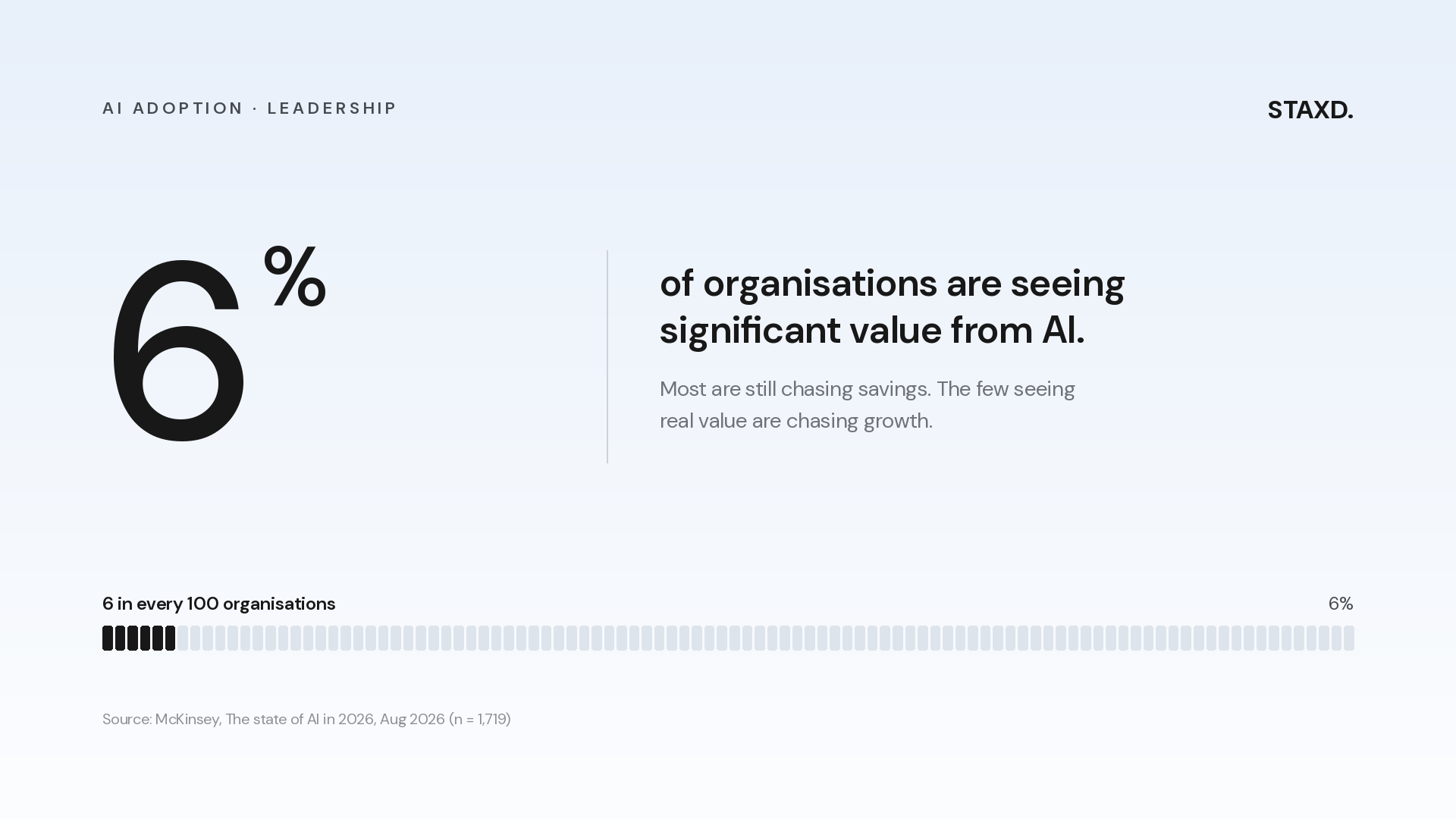
What separates that 6% isn't the cost lens. Around 80% of high performers and everyone else alike are chasing efficiency. Most high performers also use AI to pursue growth or innovation. And nearly three quarters of them have fundamentally redesigned their workflows, compared with one quarter of everyone else.
BCG's 2025 research tells the same story. The 5% of companies it calls future-built reinvest their AI returns in people and technology capabilities, and they're seeing 1.7 times the revenue growth of the companies lagging behind. Meanwhile 60% report minimal revenue and cost gains despite substantial investment.
That's the cloud story again. The technology is the easy part. The modernisation and the capability uplift are where the value is won or lost.
How I actually use it
I'll use my own business as the example.
I still bring in experts. Marketing, sales, accountancy: I tap into people who are far better at those things than I'll ever be. I'm not trying to become the accountant, the marketer or the best salesperson in the room.
What AI does is let me do things I otherwise wouldn't have done at all.
Would I have hired a team of bookkeepers, a marketing team and a group of content creators? Probably not. Now that capability is accessible. As long as my strategy is right and I'm betting on the right things, I can execute on it at a scale that simply wasn't available to me before.
That isn't replacing a function. It's a capability I couldn't have afforded to build any other way.
Don't own the function. Put the right person in it.
As business owners and directors, our goal shouldn't be to own every function ourselves. It should be to put the right person in the right seat.
AI helps you get there sooner. And once the right people are in place, it lets them do their jobs in a way that is both cost effective and scalable. One good marketer with the right AI capability behind them can execute a strategy that used to need a department.
That's the real return. Not fewer people. More capability per person, pointed at the right strategy.
This isn't about cutting jobs
If your AI plan starts with a headcount number, I'd question the plan.
Just like cloud, the jobs don't vanish. They change. The work gets done differently as people's capabilities uplift and your systems modernise enough to support it. That takes investment, and it takes time to move up the curve.
Businesses that treat AI as a technology purchase, or a cost line to trim, will get a tool. Businesses that treat it as a way to scale their strategy will get growth.
Three questions for your next board meeting
- Where is our strategy limited today by capability we can't access, rather than by cost?
- Which systems and processes need modernising before AI can actually help them?
- Who are the right people to own each function, and how will AI let them do more of it?
If those answers point to growth rather than cuts, you're looking through the right lens.
Wherever you're starting from
If you're still working out where AI fits, we can help you set the strategy and lay the foundations properly. If you're further along and ready to scale, we'll help you modernise what's holding it back and get your people working with it.
Either way, let's talk.
Get in touch to book a conversation →
Sources: McKinsey, "The state of AI in 2026: On the road to ROI," August 2026; Boston Consulting Group, "The Widening AI Value Gap: Build for the Future 2025," September 2025.
Browse all insights →
Not sure where AI fits in your business yet?
Most AI stalls on systems and leadership, not the tool. We start with your problem, then lead the work, deliver it, or both.